7 Stages of Hair Loss: The Norwood Scale Explained
The 7 stages of hair loss explain how male pattern baldness progresses from a mature hairline to extensive loss across the top. This article explains the meaning of each stage, why the pattern is important, and which treatment options make sense at each point [1][2].
Quick answer
- The Hamilton Norwood scale is the main classification system for male pattern baldness. It divides this process into seven stages that describe increasing hairline recession and crown loss [1][2].
- Acting quickly can reduce further hair loss, support hair growth, and give you more options for hair restoration or hair transplant planning later [3].
What are the 7 stages of hair loss?
The 7 stages of hair loss convey the classic progression of male pattern baldness on the Hamilton Norwood scale. James Hamilton introduced the foundation, and Norwood later refined it into the modern classification system that we use to describe the stages of male pattern change. The progress goes from a stable hairline to the most advanced stage with only a band of hair left on the sides and back [2].
Androgenetic alopecia is progressive in nature. In genetically susceptible people, hair follicles in the frontal hairline and crown gradually miniaturize (i.e., the strands become finer, shorter, and less able to cover the scalp) [4].
Over time, patients will say that:
- Hair thinning has become easier to spot.
- Hair separating has become more visible.
- Hair loss is noticeable long before an area looks completely bald.
This is why it’s very important to get assessed early on. The goal here is not to replace the lost hair and make your scalp look full again; it is to protect healthy hair follicles before severe hair loss develops [4].
The seven stages of the Hamilton Norwood scale
| Stage | What you see | Pattern on the scalp | Interpretation |
| 1 | No visible balding. | The frontal hairline looks full. | Not true male pattern baldness. |
| 2 | Slight recession at the temples. | Early mature hairline. | Could be the early stages or a mature hairline. |
| 3 | Noticeable hair loss. | Deeper temple recession. | The first stage of clear male pattern baldness. |
| 4 | More obvious front and crown change. | Hairline recession plus crown loss with a band of hair separating the two. | A clear loss pattern. |
| 5 | Significant hair loss. | Broader balding areas and a thinner bridge. | Mid-to-advanced progression. |
| 6 | Severe hair loss. | The thin band of hair across the mid-scalp is almost gone. | Advanced stage with merged loss. |
| 7 | Most severe stage. | Only a thin band of hair remains in a horseshoe pattern. | Most advanced stage. There is almost no hair on top. |
Stage 1: No visible balding
In the first stage of hair loss, there is no clear male pattern baldness. The frontal hairline looks intact, the crown looks even, and there are no bald spots or obvious balding areas [1]. Some people still worry because they shed strands in the shower. However, routine shedding is not the same as androgenetic alopecia. The hair cycle includes an active phase, a short transition, and a resting phase before shedding, so some daily loss is quite normal [5].
A physical examination is more useful than online guessing at this point. Dermatologists examine the scalp, the distribution of loss, family history, and signs of miniaturization to determine whether the pattern fits male pattern hair loss or another cause (e.g., telogen effluvium) [4]. Telling the difference between these two conditions is indispensable because telogen effluvium causes diffuse shedding and commonly improves after the trigger settles. On the other hand, male pattern baldness follows a specific pattern and tends to progress if no treatment is initiated [6].
Stage 2: Slight recession and a mature hairline

The second stage of hair loss usually shows slight recession at the temples. This can represent a mature hairline, so it’s not always pathological. This is why stage 2 does not always mean that a major loss will follow [2]. A quick look in the mirror will show that the hairline is still natural without a major crown deficit.
With that said, stage 2 is where some people first notice hair loss in photos. You may want to get a professional evaluation if one or more of these risk factors apply to you:
- You have a family history of androgenetic alopecia.
- There is a progression of hairline recession.
- You notice clear thinning in the crown area.
The treatment choices at this stage may include observation, serial photos, and over-the-counter minoxidil. The value of early care is to preserve the hair remaining before more hair loss narrows your choices [4].
Stage 3: The first clearly noticeable stage
Stage 3 is usually the first stage that some experts consider a definite male pattern baldness. The receding hairline becomes obvious, or stage 3 vertex appears with a bald patch on the crown [2]. Unfortunately, it is also the first stage where people realize that they’re losing their hair.
The good news is that this stage of hair loss still has a good chance of responding to treatment because there is considerable native coverage.
Treatments at this point aim to:
- Reduce further hair loss.
- Stimulate hair growth.
- Support healthy hair around the thinning zone.
For some patients, it is also the point where hair transplant planning begins. A conservative approach is helpful since surgery works best when it fits the pattern of likely future loss [7].
Stage 4: Clear front-and-crown separation

At stage 4, male pattern baldness becomes much more obvious. There is a deeper hairline recession, crown loss is easier to see, and a band of hair separating the front from the crown is still present [2]. That band of hair is important because it marks the difference between a moderate pattern and the more advanced stages that follow [2].
Treatments at stage 4 follow more rigorous guidelines. For example, some patients do well with medications that slow male pattern hair loss and promote hair growth. Others will start to have serious conversations about hair transplantation [3]. If the donor zone is eligible, a hair transplant could be a great way to rebuild the frontal hairline and add coverage where the cosmetic change is greatest. Still, surgery does not stop male pattern baldness, so long-term hair restoration must protect the surrounding hair as well [3][7].
Stage 5: Broader balding areas and a thinner bridge
The fifth stage of hair loss shows significant hair loss. The frontal and crown regions expand, and the band of hair separating them becomes much thinner [2]. Hair separating through the middle becomes easier to see, the scalp shows more clearly, and styling options become more limited.
At this point, hair loss treatments may still slow further hair loss, but expectations must stay realistic. Hair transplant procedures can still work well, but the donor supply is limited. Therefore, the treatment plan has to respect how much hair may still be lost later [4].
Good surgical planning focuses on natural framing and durable density and does not try to recreate a juvenile hairline in one step [7].
Treatment options by stage of hair loss
| Stage | Goal | Treatment Choices | Hair transplant? |
| 1-2 | Confirm the diagnosis and monitor the change. | Physical exam, serial photos, over-the-counter minoxidil, and scalp care. | Usually not first-line. |
| 3 | Preserve density and slow progression. | Minoxidil, finasteride for eligible men, and early hair restoration planning. | Discussed in stable frontal loss. |
| 4-5 | Improve coverage and protect existing hair. | Combination therapy, donor assessment, possible hair transplantation, and scalp micropigmentation. | A common part of planning. |
| 6-7 | Maximize cosmetic coverage with realistic goals. | Hair transplant for some cases, scalp micropigmentation, shaving, and supportive care. | It depends heavily on donor quality. |
Stage 6: Advanced loss with minimal separation
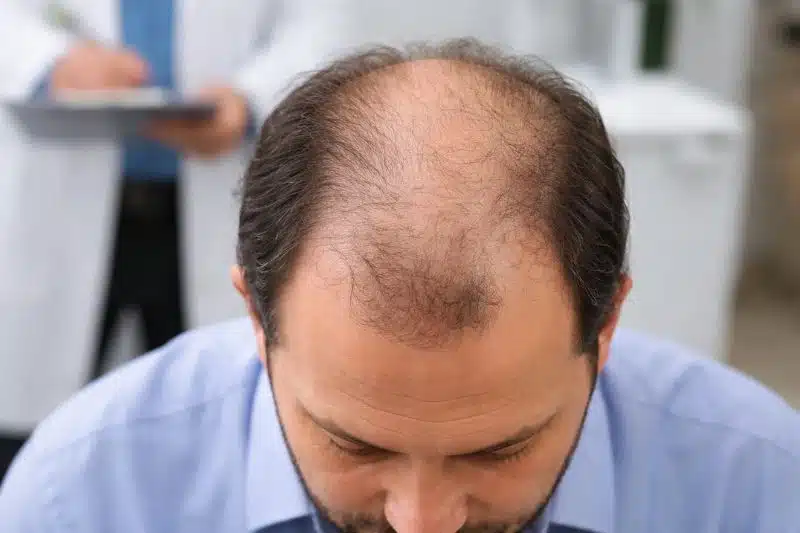
In stage 6, the band of hair that separates the front and crown is nearly gone. The balding areas merge, severe hair loss is obvious, and coverage across the top becomes sparse hair at best [2]. This advanced stage changes the equation of treatment because a larger surface has to be addressed with a limited donor supply.
Patients in stage 6 still have treatment options, but we might alter the strategy a bit. For instance, medication may help preserve hair remaining, but it cannot recreate dense coverage across a broad zone [4].
Hair transplant can still help eligible patients, especially when the goal is to improve appearance instead of completely reversing hair loss. Scalp micropigmentation at Maxim Hair Restoration is another option for people who want the appearance of fuller coverage [8].
Stage 7: The most advanced stage
Stage 7 is the most severe stage on the Norwood scale. Here, only a thin band of hair remains around the sides and back, the top may look completely bare, and the classic horseshoe pattern is fully established [2]. This is the severe stage that many people picture when they think of advanced male pattern baldness.
Even here, treatment is not pointless. The right treatment depends on donor quality, contrast between skin and hair, styling preference, and how much hair can realistically be moved [7].
Some patients choose a selective hair transplant to rebuild a soft frontal frame. Others prefer scalp micropigmentation or a close shave. In both cases, honest planning is very important since promises of full reversal are misleading [8].
How male pattern baldness is diagnosed
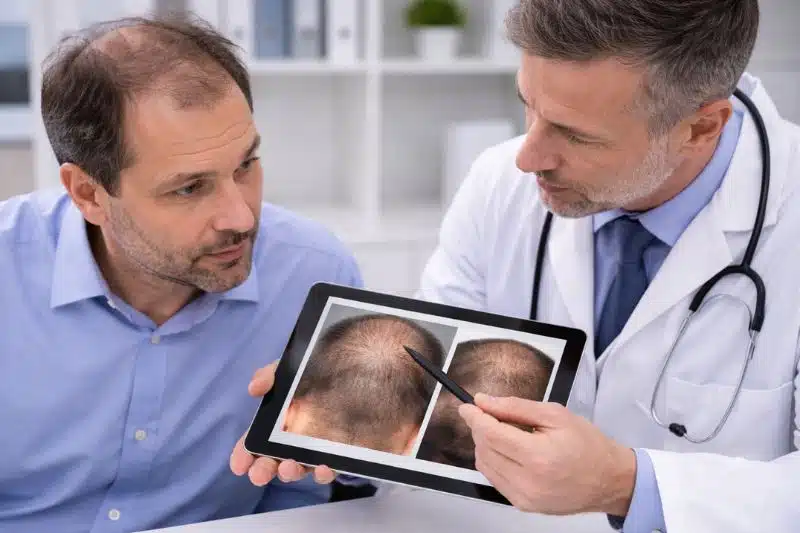
Male pattern baldness diagnosed correctly depends on pattern recognition.
Dermatologists spend years learning how to assess the stage of hair loss, family history, inflammation, the scalp, and the distribution of thinning. The Hamilton Norwood scale is useful to classify male pattern hair loss in men. Other forms of hair loss may need different tools [4]. When the pattern is unusual, clinicians will use trichoscopy and/or order blood [4].
Once again, not every case of thinning hair is androgenetic alopecia. Telogen effluvium causes diffuse shedding due to illness, stress, and physiological change (e.g., pregnancy). According to the Cleveland Clinic, telogen effluvium improves once the trigger resolves [6].
Another cause of hair loss is alopecia areata, which is an autoimmune disease that causes sudden bald spots. We also have traction alopecia, which comes from chronic pulling on the scalp. All in all, the Norwood scale is useful only when the loss follows the expected specific pattern [3][6].
Why do the seven stages progress
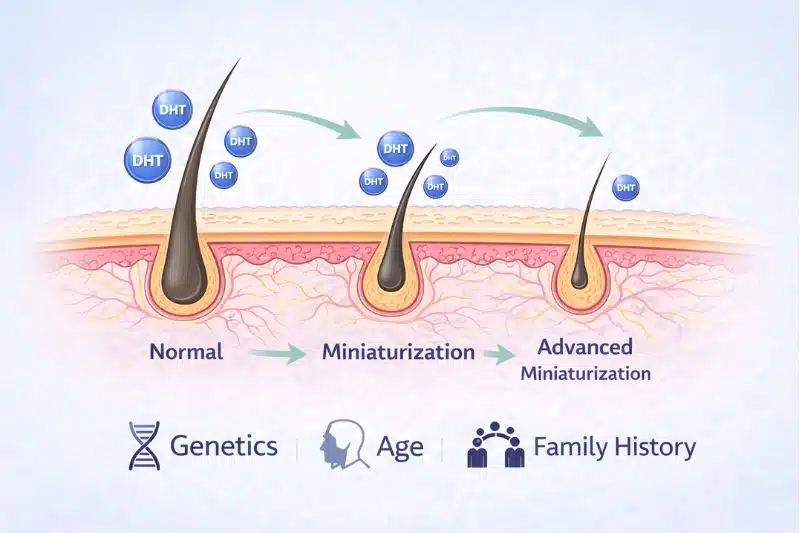
The simple answer is miniaturization. In male pattern baldness, sensitive hair follicles respond to androgens (e.g., DHT) by shrinking over time. This process shortens visible growth, reduces shaft diameter, and makes the scalp easier to see even before an area looks fully empty [1].
Genetics is the most important factor here. Additionally, age and family history also play an important role [4]. Because the process is gradual, people who act in the early stages usually preserve more options for hair restoration later [3][4].
Because hair loss follows predictable patterns, it is important to focus on medically recognised causes. Some men still ask does masturbation cause hair loss? Evidence confirms that male pattern baldness is driven by genetics and hormonal factors, not sexual activity.
Best treatment options for the 7 stages of hair loss
The best plan is widely dependent on the stage of hair loss, the pattern, and the patient’s goals. The most established medical choices for male pattern baldness are minoxidil and finasteride. The American Academy of Dermatology (AAD) states that treatment can reduce hair loss and that some men regrow a bit of coverage. Usually, the best results are seen when treatment starts soon after patients notice a loss. Keep in mind that oral finasteride has some eligibility criteria for men, whereas minoxidil is an over-the-counter option [3].
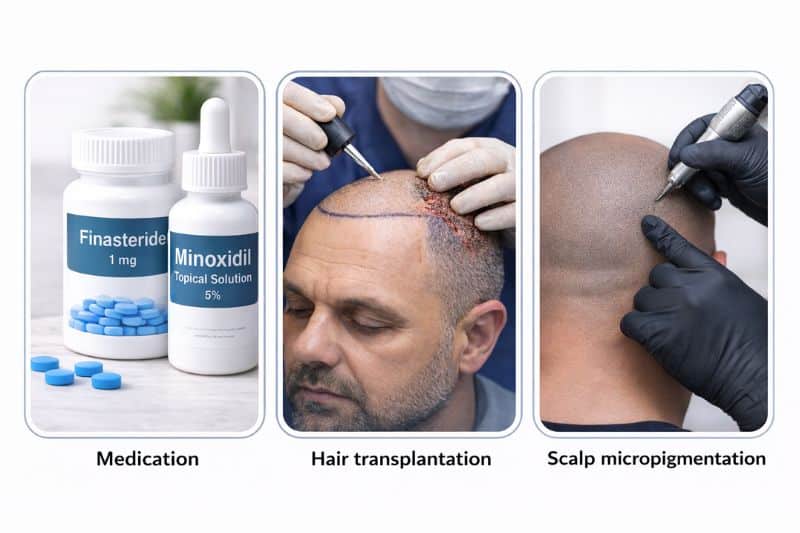
Hair transplant remains the most established surgical method for permanent redistribution of resistant follicles. The AAD states that most patients see results between six and nine months after surgery [7].
For advanced stages of hair loss, a more aggressive hair restoration plan may consist of:
- Medication (e.g., minoxidil, finasteride).
- Hair transplantation.
- Scalp micropigmentation.
Conclusion
The 7 stages of hair loss are very useful to break down the vague process of male pattern hair loss into digestible steps. The Hamilton Norwood scale distinguishes between a mature hairline, a first stage of obvious male pattern baldness, and the most advanced stage.
The value of this staging system is to determine the right treatment at the right moment. Your doctor will choose to either do a watchful follow-up, medication, scalp micropigmentation, or hair transplant.
If you notice loss at the temples or crown, an expert assessment can clarify whether the pattern fits male pattern baldness or another cause. Our team of hair loss experts offers medical and surgical hair restoration options tailored to your stage of hair loss, donor supply, and cosmetic goals.
Frequently Asked Questions (FAQ)
1. What are the 7 stages of hair loss, and why are they important?
The 7 stages of hair loss refer to the Hamilton Norwood scale, which shows how male pattern baldness progresses from a full hairline to advanced thinning across the crown and top of the scalp. Understanding these stages helps you recognize early changes, monitor progression, and choose the right treatment at the right time. Early action can slow hair loss and preserve more options for hair restoration.
2. What is stage 3 hair loss?
Stage 3 hair loss is usually the first clear stage of male pattern baldness. It shows deeper temple recession, a visible receding hairline, and early crown loss.
3. Can stage 2 hair loss be normal?
Yes. Stage 2 can be a sign of a mature hairline. The major question is whether the pattern stays stable or keeps progressing.
4. Is Stage 7 hair loss completely bald?
Not exactly. Stage 7 means the top is nearly or fully bare. However, you can still see a band of hair around the sides and back.
5. Can a hair transplant work at every stage?
Not always. A hair transplant can help a wide range of patients, but the result depends on donor quality, future hair loss, and realistic goals.
6. Can hair loss be stopped or reversed at early stages?
In early stages, treatments like minoxidil or finasteride can slow progression and sometimes improve hair density. While complete reversal is not always possible, starting treatment early significantly improves long-term outcomes.
References
[1] Asfour, L., & Cranwell, W. (2023). Male androgenetic alopecia. Endotext. National Center for Biotechnology Information. (NCBI)
[2] Gupta, M., Mysore, V., et al. (2016). Classifications of patterned hair loss: A review. International Journal of Trichology, 8(1), 3–12. (PubMed Central)
[3] American Academy of Dermatology Association. (2022). What is male pattern hair loss, and can it be treated? (American Academy of Dermatology)
[4] Ho, C. H., Sood, T., & Zito, P. M. (2024). Androgenetic alopecia. StatPearls. National Center for Biotechnology Information. (NCBI)
[5] Hoover, E., & Krishnamurthy, K. (2023). Physiology, hair. StatPearls. National Center for Biotechnology Information. (NCBI)
[6] Cleveland Clinic. (2022). Telogen effluvium: Symptoms, causes, treatment & regrowth. (Cleveland Clinic)
[7] American Academy of Dermatology Association. (n.d.). A hair transplant can give you permanent, natural-looking results. (American Academy of Dermatology)
[8] Cleveland Clinic. (2022). Scalp micropigmentation: Before & after, benefits, side effects, cost. (Cleveland Clinic)