Non-Surgical Hair Restoration: What Actually Works
Non-surgical hair restoration is a very intriguing topic for people who see more scalp, more shedding, and less density, but want a credible answer before they consider surgery. The problem is that this topic is loaded with exaggerated promises, which is why it is very important to take an evidence-based look away from marketing.
This guide will explain what non-surgical hair restoration can realistically do, who benefits the most, and which treatments have the strongest support in current literature.
At a Glance
- Non-surgical hair restoration works best when follicles are still present, especially when the cause of hair loss is identified early.
- The most evidence-based options for common pattern loss are minoxidil, finasteride, platelet-rich plasma, and low-level laser therapy.
What does non-surgical hair restoration really mean?
Non-surgical hair restoration describes medical and regenerative care that reduces hair loss, supports the scalp, preserves existing follicles, and improves visible coverage without hair restoration surgery.
In simpler terms, it is mostly useful before a patient reaches the stage at which surgical hair restoration provides a better cosmetic result. This distinction is very important because many people do not need a hair transplant as a first step.
For instance, early androgenetic alopecia, diffuse thinning hair, and some cases of female pattern baldness may respond well to non-surgical hair restoration. Conversely, patchy bald spots may be a sign of alopecia areata or another diagnosis that needs a different plan.
The American Academy of Dermatology notes that the evaluation of hair loss must include the following items [1]:
- A thorough medical history.
- Scalp examination.
- Blood tests.
- A biopsy from the bald area.
- Tests to detect nutritional deficiencies.
- An endocrine assessment for hormonal imbalances.
The National Institute of Arthritis and Musculoskeletal and Skin Diseases (NIAMS) states that alopecia areata is an autoimmune condition in which the immune system attacks hair follicles, which causes small and round patches on the head or face [2].
Why is the diagnosis of hair loss type important?

A patient who is getting treated for hair loss without a diagnosis could potentially lose time, money, and confidence. As we mentioned above, hair loss issues can come from hereditary miniaturization, hormonal imbalances, inflammation, traction, postpartum change, medication effects, and autoimmune disease. Obviously, these causes do not respond equally to the same treatment [1][2].
It’s very important to get a comprehensive assessment that consists of a medical history, timing of hair loss, family history of similar cases, other symptoms, and whether the body shows other clues that change the workup.
A diagnostic plan should also identify whether the follicles are miniaturized, dormant, inflamed, or permanently gone. This is the point at which non-surgical hair restoration and surgical hair restoration start to separate. One protects recoverable follicles. The other one redistributes permanent donor follicles when the loss pattern has advanced too far [4].
Who is most likely to benefit from non-surgical hair restoration?

The best candidate for non-surgical hair restoration is usually someone with active but weakened follicles. This includes men and women with early androgenetic alopecia, a widening part, reduced density at the crown, or diffuse thinning that still has recoverable coverage.
It also suits people who want natural-looking results, less invasive procedures, and a delayed surgery [3][4].
The biggest limitation is that non-surgical care cannot reliably rebuild an area where follicles are no longer viable. If that’s the case, surgical hair restoration or other surgical hair restoration treatments may be more suitable. Of course, these scenarios don’t completely exclude medical treatment. In fact, non-surgical hair restoration still improves the surrounding scalp and supports a stronger long-term outcome before or after surgical hair restoration treatments [1][4].
For additional stimulation, consider incorporating a regular scalp massage for hair growth into your routine. Structured scalp exercises can further support circulation and improve nutrient delivery to the hair follicles, complementing proper washing techniques.
The conclusion is that the earlier the consultation, the more effective the treatment options are. Patients who want a specialist opinion can request a free consultation at Maxim Hair Restoration Clinic.
Non-surgical treatments for hair growth and hair restoration
It is very important to understand the evidence behind non-surgical hair restoration options. Currently, the strongest research for common pattern loss sits with minoxidil, finasteride, platelet-rich plasma, and low-level laser therapy.
| Treatment | Main role | Best fit | Limitation |
| Minoxidil | Supports hair growth and reduces ongoing shedding. | Early pattern loss and diffuse thinning. | Needs long-term intake for lasting results. |
| Finasteride | Reduces DHT-driven miniaturization. | Male pattern hair loss. | Requires prescription and side-effect monitoring. |
| Platelet-rich plasma | Uses blood-derived growth factors to enhance follicle activity. | Early to moderate loss in men and women. | Repeated office sessions are necessary. |
| Low-level laser therapy | Uses light energy to support the growth phase. | Patients who want a non-surgical device option. | The benefits depend on regular use over time. |
Minoxidil for hair growth
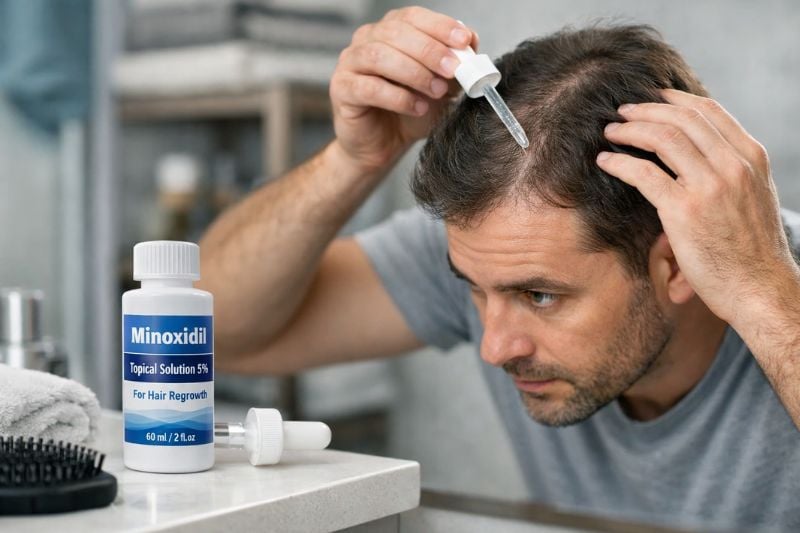
Minoxidil is still one of the most established options in non-surgical hair restoration. The AAD states that minoxidil can help with early thinning hair. At the same time, DailyMed notes that topical minoxidil is excellent for gradual thinning on the top of the scalp but not very effective for patchy loss [1][3].
For everyday use, minoxidil is applied topically to the scalp to stimulate hair growth and improve density over several months. However, no one can predict the response in advance. Additionally, the overuse of the drug does not necessarily mean it will work faster. Mayo Clinic also notes that visible change usually takes several months and that the benefits fade shortly after the treatment stops [3].
All of this data makes minoxidil a long-term treatment and not a one-time procedure. It can reduce hair loss and support improved hair growth, but it works best for committed patients who take regular photographs, go for follow-ups, and have realistic expectations. It may be necessary to see a doctor if irritation and initial shedding appear.
Finasteride for hair growth stimulation
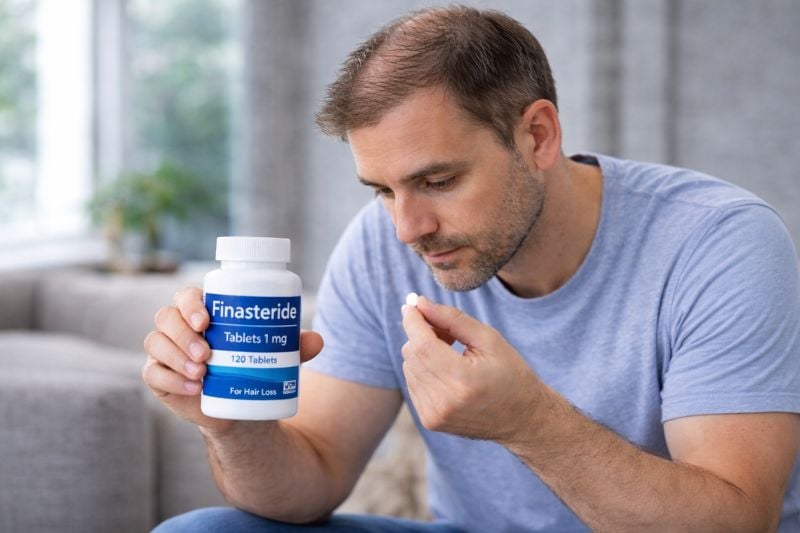
Finasteride is another medication that’s highly researched for hair restoration. It is approved by the Federal Drug and Food Administration (FDA) for male pattern hair loss in men only. A systematic review found moderate-quality evidence that the daily intake of oral finasteride improves the count and appearance of hair follicles. At the same time, it increases the risk of sexual side effects [4][5].
This is why finasteride has a clear role in non-surgical hair restoration when androgen-driven miniaturization is the main issue. It can preserve follicles that are still present, slow further loss, and delay the point at which surgery becomes inevitable. It can also support long-term planning before surgical hair restoration or after other surgical hair restoration treatments [4][5].
With all of that said, finasteride is still not a universal answer. It requires discussion of side effects, contraindications, and patient goals. The best treatment is not the most famous one. It is actually the one that fits the diagnosis, the patient, and the expected risk-benefit balance [4][5].
Platelet-rich plasma – Growth factors for hair restoration

Platelet-rich plasma (PRP) has gained some massive traction over the past few years as a modern non-surgical hair restoration technique. Interestingly, there is some solid evidence behind this procedure. PRP starts by collecting the patient’s blood. After that, a concentrated fraction that’s rich in growth factors is returned to the scalp through small punctures. The goal is to optimize the environment for the hair follicle, blood vessels, and new hair growth [6].
A 2023 systematic review and meta-analysis of randomized trials found that platelet-rich plasma increased the density of hair follicles at 3 and 6 months compared with placebo in androgenetic alopecia. Moreover, there were no reported adverse reactions. A separate meta-analysis in women found better terminal density without major side effects. However, the authors stated the results should be taken with a grain of salt due to the limited samples [6].
Low-level laser therapy for hair growth
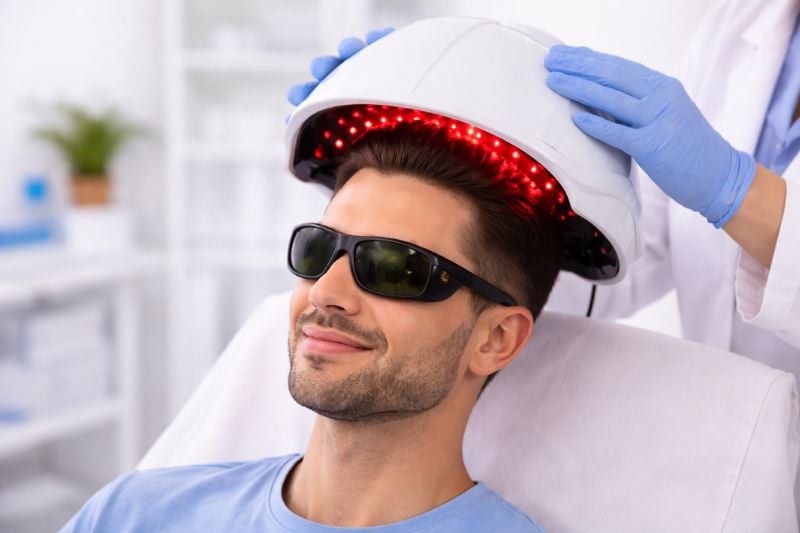
Low-level laser therapy has become a legitimate part of the conversation. This treatment uses red or near-infrared light to stimulate hair follicles, support blood circulation, and shift follicles toward the growth phase. It is non-surgical, painless, and suitable for daily activities immediately after each session [7][8].
The evidence is stronger than many people think. For instance, a 2021 meta-analysis of FDA-approved home-use devices found a significant increase in hair density compared with sham treatment. What’s more, a 2024 systematic review and meta-analysis that included 3,098 patients also found significantly increased density in androgenetic alopecia after 4 to 26 weeks of use compared with placebo [7][8].
This treatment may be especially useful for patients who prefer a home appliance and want to adopt a more comprehensive hair restoration plan.
When is non-surgical care enough?
A common mistake is to think of non-surgical hair restoration and surgical hair restoration as opposing choices. In reality, they could work well together.
Medical and regenerative care preserve native coverage, whereas surgical hair restoration becomes more useful when a bare area is established, and recoverable follicles are limited [1].
This is why some patients attempt non-surgical hair restoration first and later move to surgical hair restoration treatments.
- If the goal is to reduce hair loss, preserve density, and delay a future hair transplant, early treatment makes sense.
- If the goal is to rebuild an area where follicles are largely gone, surgery or another surgical procedure may provide a more visible change.
Takeaway Message
A realistic treatment plan should define the diagnosis, severity of symptoms, expected timeframe, and what success looks like. It should also explain that most medical options do not produce instant cosmetic change. Several months are expected before we can judge a response. To objectively quantify the improvements, photos and scheduled follow-ups should be scheduled.
If you’re considering your next step, Maxim Hair Restoration offers a full range of solutions- from non-surgical treatments to advanced procedures like FUE, FUT, and scalp micropigmentation. You can explore all available options or find a doctor in your area to get a personalized assessment based on your hair loss pattern.
Frequently Asked Questions (FAQs)
1. What is the best non-surgical hair restoration option?
The best option depends on the diagnosis. For male pattern hair loss, the strongest evidence supports minoxidil and finasteride, platelet-rich plasma, and low-level laser therapy.
2. How long does non-surgical hair restoration take?
Most patients need several months before they see a visible change. It’s crucial to stick to the treatment protocol, get regular photographs, and schedule follow-ups.
3. Can non-surgical hair restoration replace a hair transplant?
No, not in every case. It can delay a hair transplant and preserve native density, but it cannot fully replace follicles that are permanently gone.
4. Does this approach work for alopecia areata?
Alopecia areata has a completely different pathophysiology compared to pattern hair loss. Because it is an autoimmune disease, it needs a diagnosis-led plan and not a generic shedding routine.
References
[1] American Academy of Dermatology Association. (2022, December 13).Hair loss: Diagnosis and treatment.
[2] National Institute of Arthritis and Musculoskeletal and Skin Diseases. (2024, August 28).Alopecia areata.
[3] DailyMed. (n.d.).Minoxidil topical solution.
[4] U.S. Food and Drug Administration. (2012).PROPECIA (finasteride) prescribing information.
[5] Mella, J. M., et al. (2010).Efficacy and safety of finasteride therapy for androgenetic alopecia: A systematic review.
[6] Zhang, X., et al. (2023).Platelet-rich plasma for androgenetic alopecia: A systematic review and meta-analysis of randomized controlled trials.
[7] Lueangarun, S., et al. (2021).A systematic review and meta-analysis of randomized controlled trials of FDA-approved home-use low-level light/laser therapy devices for pattern hair loss.
[8] Perez, S. M., et al. (2024).Low-level laser and LED therapy in alopecia: A systematic review and meta-analysis.